Anticipation Effects in Vehicle Markets: Evidence from Sweden’s Feebate Policy∗
Abstract
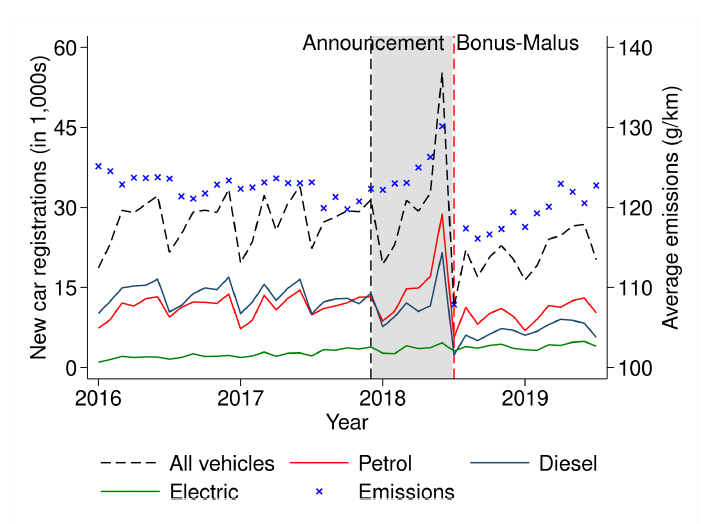
We study anticipatory behavior in response to Sweden’s vehicle feebate policy, a reform announced seven months prior to implementation that subsidizes low-emission vehicles while imposing higher road taxes on high-emission vehicles. Using administrative data on vehicle registrations linked to individual and firm characteristics, we document that the early policy announcement caused anticipatory vehicle adoption, largely reflecting intertemporal substitution but also generating modest excess purchases. To avoid the forthcoming higher road taxes, households and firms systematically brought forward the adoption of more emissions-intensive vehicles, resulting in a dirtier composition of the vehicle fleet ahead of implementation. Anticipatory adoption is most pronounced among those for whom acting early is easiest or adapting to the policy is most costly. Dealer stock-management strategies, household and firm liquidity, and information salience amplify anticipatory purchases, while access to charging infrastructure mitigates them by lowering the cost of switching to cleaner vehicles. We develop an empirical framework to quantify the environmental implications of anticipatory behavior, accounting for excess adoption, the higher emissions intensity of pre-implementation purchases as well as the benefits from the accelerated fleet turnover, and estimate total environmental costs of approximately $28.39 million — around 21 percent of the policy’s 2019 budget and 19 percent of its lifetime environmental benefits in 2019.